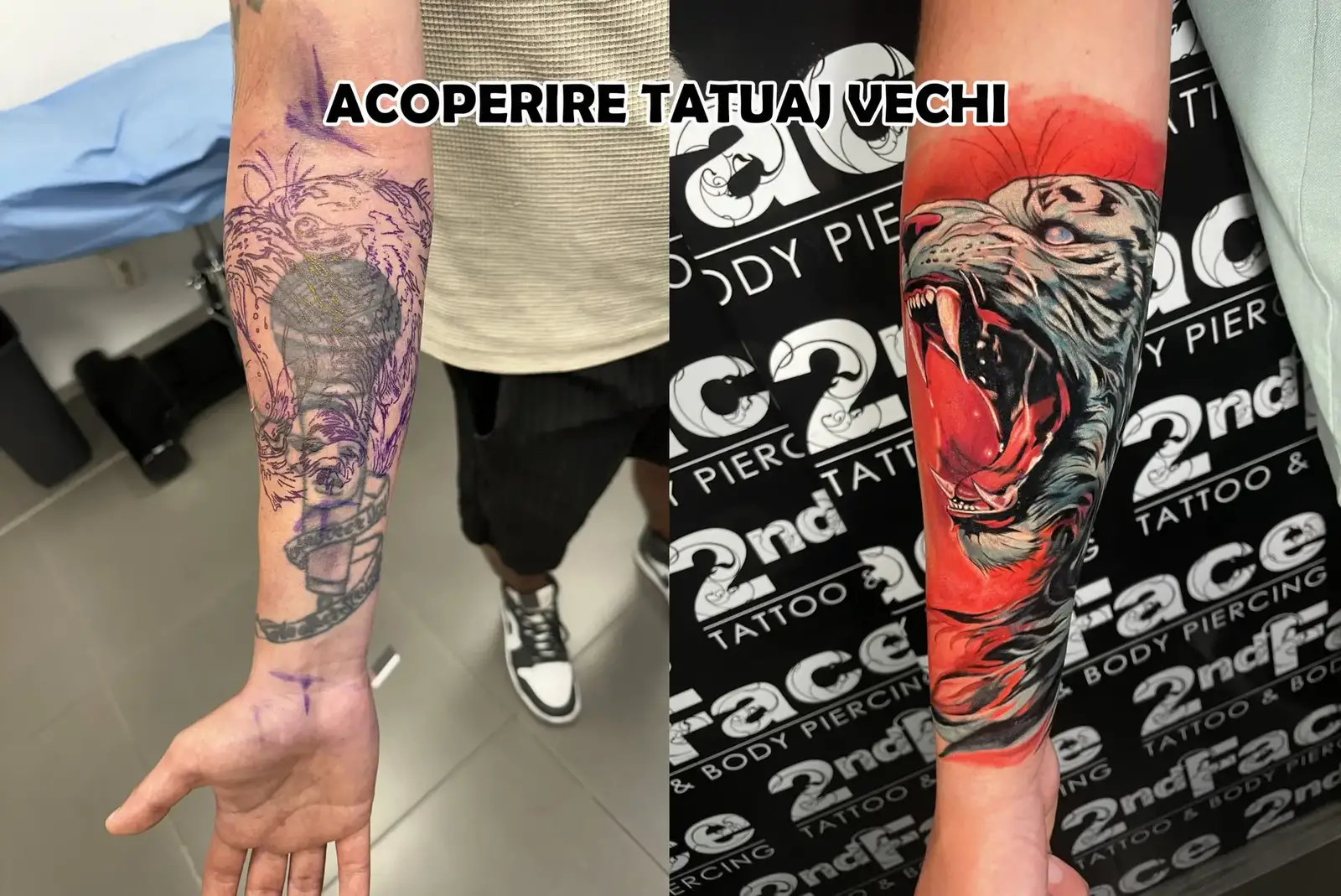
An old tattoo.
A new composition.
The cover-up transforms an unwanted tattoo into a new project, adapted to the colour, shape, size, and anatomy of the area.
What is a cover-up?
A cover-up is a new tattoo designed to visually integrate and cover an old tattoo. The design is not simply applied "over" the tattoo but is strategically built around the existing shapes, shadows, and dark areas.
You don't hide the tattoo. You visually reconstruct it.
A successful cover-up starts with a realistic evaluation of the existing pigment and a design that intelligently uses shadows, texture, and composition direction.
Integration.Not simple overlay.
The artist analyses the old tattoo, identifies the areas to be masked, and creates a new design large and contrasting enough to work.
How a cover-up is created.
The process starts with evaluating the old tattoo and continues with choosing a realistic visual direction.
Evaluation.
Colour, density, scars, size, and position are analysed.
Concept.
A theme is chosen that can integrate the existing lines and shadows.
Composition.
The new design is usually larger and more complex.
Execution.
Old areas are masked through contrast, texture, and careful distribution.
The old tattoo must be fully healed.
A cover-up is not done over a recently tattooed, inflamed, or incompletely healed area. The skin must be stable, without scabs, active redness, or marked sensitivity.
If the tattoo is old but there are scars, relief, or skin reactions, these must be evaluated before starting the project.
A lighter tattoo offers more freedom.
The lighter and less dense the old pigment, the more colour and composition options the artist has. A very dark, compact, or multi-layered tattoo limits the options.
In some cases, fading through a few laser sessions can reduce pigment density and allow a cleaner result. See the page about laser tattoo fading and removal.
The new tattoo is usually larger.
To visually control the old tattoo, the new design must exceed its edges and create a coherent composition. A project that is too small can highlight the old tattoo even more.
The final size is determined according to anatomy, project direction, and how much space is needed for details.
Not just Tribal or Celtic.
Tribal and Celtic designs can work in some cases due to black surfaces and contrast, but they are not the only options.
Realism, black & grey, neo-traditional, ornamental, floral, biomechanical, or colour compositions can be suitable, depending on the existing tattoo and the artist's experience.
What influences the difficulty.
Not all tattoos can be covered in the same way.
How dark it is.
Dense black and saturated colours limit the new project's palette.
How large it is.
Extended tattoos require a new, larger composition.
How it is distributed.
Old lines, shadows, and shapes must be integrated into the design.
If there are other cover-ups.
Multiple overlays increase difficulty and pigment density.
Scars and relief.
Scar tissue can react and retain pigment differently.
Body anatomy.
The shape and mobility of the area influence the final composition.
When fading with laser before cover-up is useful.
Laser is not mandatory for every case. It may be recommended when the tattoo is very dark, compact, or does not allow the desired artistic direction.
Even partial fading can offer more options for colour, detail, and size.
Useful pages.
Continue researching before choosing the project direction.
Send a clear photo and say what you want to achieve.
Request an evaluationSee works and styles suitable for complex projects.
View our portfolioThe cost depends on size, complexity, and working time.
See pricesFind out when fading can help before cover-up.
See laser procedurePreparation, positioning, healing, and maintenance.
Read the guideCOCOR store, in the basement, near Unirii Square, Bucharest.
See the contactFrequently asked questions.
Can any tattoo be covered?
Not in all conditions. Some tattoos are too dense, too large, or have scars that limit options. Direct evaluation is necessary.
Does the new tattoo have to be larger?
Most of the time, yes. Space is needed to integrate old shapes and for a coherent new composition.
Can colour be used in a cover-up?
Yes, but the palette depends on the existing pigment. Light colours cannot effectively cover a very dense black tattoo without an appropriate strategy.
Are Tribal or Celtic designs mandatory?
No. They can be suitable in some cases, but there are many other effective styles depending on the old tattoo and the new concept.
Is laser needed beforehand?
Not always. Laser may be recommended for fading when the tattoo is too dark or limits the new design too much.
How long should I wait after laser?
Cover-up is done only after the skin has fully recovered. The interval is set according to progress and specialist recommendation.
How do I get an estimate?
Send a clear photo, approximate size, body area, and desired idea via the page Send design.
Experience and verifiable information.
2nd Face Tattoo & Body Piercing is located in the COCOR Store, near Piața Unirii, Bucharest.
Each project is analysed according to pigment, anatomy, scars, and objective.
The composition is specially created to integrate the existing tattoo.
Fading may be recommended when it realistically improves the chances of a better result.
The estimate depends on size, complexity, style, and number of sessions.
Content updated in July 2026 and adapted to 2nd Face Tattoo services.
Important note: a cover-up does not guarantee the complete disappearance of every detail of the old tattoo. The result depends on pigment, skin, scars, size, and the direction of the new design. Evaluation from photos is indicative.
Send a photo of the tattoo.
Tell us what you would like to change and receive an initial evaluation for cover-up or laser fading.