When you should
you give up a piercing.
Sometimes the problem is solved by a more suitable jewellery. Other times medical evaluation or controlled removal is necessary.
Should you immediately remove the jewellery if the piercing has problems?
Not always. If you suspect an infection, do not remove the jewellery on your own before medical evaluation. The channel can close quickly and block drainage. However, migration, rejection, tissue thinning or jewellery embedding may require prompt intervention.
Not every irritation means you have to lose the piercing.
Problems can have different causes: pressure, jewellery too short, wrong angle, irritating material, hits, excessive care or infection.
Evaluate the cause.Do not remove the jewellery randomly.
An experienced piercer can identify mechanical and jewellery problems, and a doctor should be consulted for signs of infection, severe reactions or general symptoms.
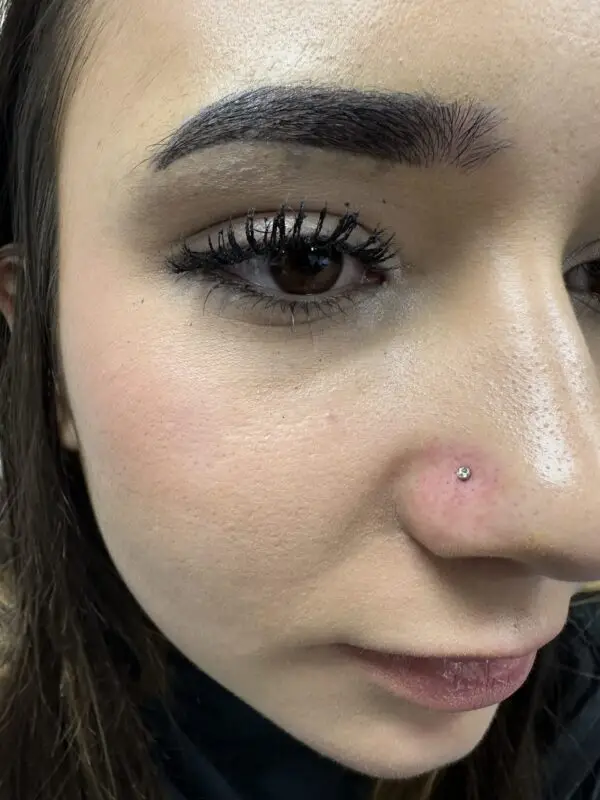
Situations that require attention.
The decision may differ depending on the cause of the problem.
Pain, heat and discharge.
Increasing swelling, very warm skin, pus, extensive redness, fever or chills require rapid medical evaluation.
Jewellery migration.
The tissue between holes becomes thinner, the jewellery becomes more visible through the skin or the position progressively changes.
Jewellery enters the tissue.
The jewellery end is swallowed by the skin, pressure increases or there is no space left for swelling.
Itching and rash.
A red, itchy and persistent rash may indicate metal sensitivity, often to nickel, or to a cleaning product.
Raised or growing tissue.
A lump is not automatically a keloid. Granuloma, hypergranulation, hypertrophic scar and keloid require different evaluations.
Snagging, pressure, hits.
Sports, professional equipment, helmets, clothing or sleeping directly on the piercing can hinder healing.
When the problem must be evaluated by a doctor.
A new piercing can be sensitive and slightly swollen, and a pale discharge that forms a crust may appear during healing. More concerning are increasing pain, a very warm area, spreading redness, thick yellow, green or foul-smelling discharge, red lines on the skin, fever, chills or a general feeling of illness.
In this situation, do not automatically remove the jewellery. Seek medical advice, as closing the surface opening can prevent drainage.
When the piercing is no longer stable in the tissue.
Rejection occurs when the body gradually pushes the jewellery towards the surface. The skin between the holes thins, the position changes, and the bar becomes increasingly visible through the tissue.
Continuing to wear it can lead to skin rupture and a larger scar. Contact your piercer promptly for controlled removal and area evaluation.
Giving up the material does not necessarily mean giving up the piercing.
Intense itching, rash, dry skin or persistent inflammation may be associated with contact dermatitis. Nickel is a common allergen in jewellery.
Sometimes the problem can be solved by professional replacement with suitable jewellery, for example titanium suitable for implants, after evaluating the channel. Also consult the guide about piercing jewellery materials.
General conditions can alter the body's response.
Uncontrolled diabetes, diseases affecting immunity, immunosuppressive treatments, coagulation disorders or anticoagulant medications can influence healing and the risk of complications.
Do not stop or change prescribed treatments. Discuss with the doctor who knows your history and inform the piercer before any procedure.
When the piercing becomes incompatible with your activity.
A piercing can be repeatedly traumatised by sports equipment, helmet, uniform, protective tools or professional rules. In some situations, a suitable retainer can be used temporarily if the piercing is sufficiently healed and rules permit.
If pressure and snagging cannot be avoided, giving up can prevent ruptures and scars.
You can give up even without a medical complication.
If you no longer want the piercing, it can be removed by you only if it is healed and there are no signs of infection or embedding. The safer option is removal by a piercer.
Continue gentle cleaning until the opening closes. Even after healing, a small spot or discreet scar may remain.
When to seek urgent medical help.
Do not wait for severe symptoms to resolve on their own.
When to remove jewellery and when to keep it temporarily.
In suspected infection, the doctor may recommend keeping suitable jewellery or a substitute for drainage.
In migration, advanced rejection, rupture, embedding or anatomical incompatibility, the piercer or doctor may recommend removal.
Related pages.
Useful information for evaluating and caring for a problematic piercing.
Correct hygiene steps and products to avoid.
Read the guideAnswers about healing, jewellery, age and appointments.
See piercing FAQTitanium, surgical steel, niobium, gold, and other materials.
See materialsChecking, changing and procedures with the client's jewellery.
See procedureList of services and conditions applicable to each procedure.
See pricesCOCOR Store, near Piața Unirii, Bucharest.
See the contactFrequently asked questions.
Should I remove the piercing if it seems infected?
Do not remove it automatically. Seek medical evaluation, as closing the channel can block drainage and promote abscess formation.
When is rapid removal recommended?
In migration or advanced rejection, very thin tissue, embedded jewellery, rupture or significant trauma. The decision must be made with the piercer or doctor.
Does an allergy mean I must give up permanently?
Not necessarily. Sometimes switching to a more suitable material can solve the problem, but professional evaluation is necessary.
What is piercing rejection?
It is the progressive movement of the jewellery towards the skin surface, accompanied by thinning of the tissue between the holes.
Is a lump always a keloid?
No. It can be irritation, granuloma, hypergranulation, hypertrophic scar or keloid. The correct diagnosis must be made by a specialist.
Can an old piercing close?
Yes. Even old channels can shrink or close after jewellery removal, and the speed varies from person to person.
How do I properly give up a piercing without problems?
If healed and no signs of infection, the jewellery can be removed by a piercer, and the area cleaned gently until closure.
Experience and verifiable information.
2nd Face Tattoo & Body Piercing is located in the COCOR Store, near Piața Unirii, Bucharest.
The size, shape and material of the jewellery can be checked by the piercer.
Infection, severe allergy and general symptoms must be evaluated by a doctor.
Not all complications require losing the piercing, but some require rapid removal.
NHS, Mayo Clinic, American Academy of Dermatology and Association of Professional Piercers.
Content reviewed in July 2026.
Medical note: This material is informative and does not replace consultation. For breathing difficulties, severe swelling of the tongue or throat, fever, chills, red lines on the skin or a generally affected condition, seek immediate medical help.
Do not make the decision alone when complications arise.
Contact the studio for jewellery evaluation and seek medical help when symptoms suggest infection or a severe reaction.