Piercing risks.
Informed decision.
Infections, reactions to jewellery, bleeding, migration and complications specific to each area.
What are the risks of a piercing?
Any piercing temporarily creates an opening in the skin or mucous membrane barrier. Infections, reactions to jewellery material, bleeding, haematoma, abnormal scarring, migration, rejection or area-specific complications may occur. Risks can be reduced by anatomy evaluation, sterile technique and consistent care, but cannot be completely eliminated.
Safety starts beforehand.Anatomy assessment, jewellery choice and hygiene influence healing.
A correct procedure is not just about piercing. Marking, angle, jewellery size, tissue pressure and care instructions matter.
How to reduce risks.
Risks do not disappear completely but can be reduced by some essential measures.
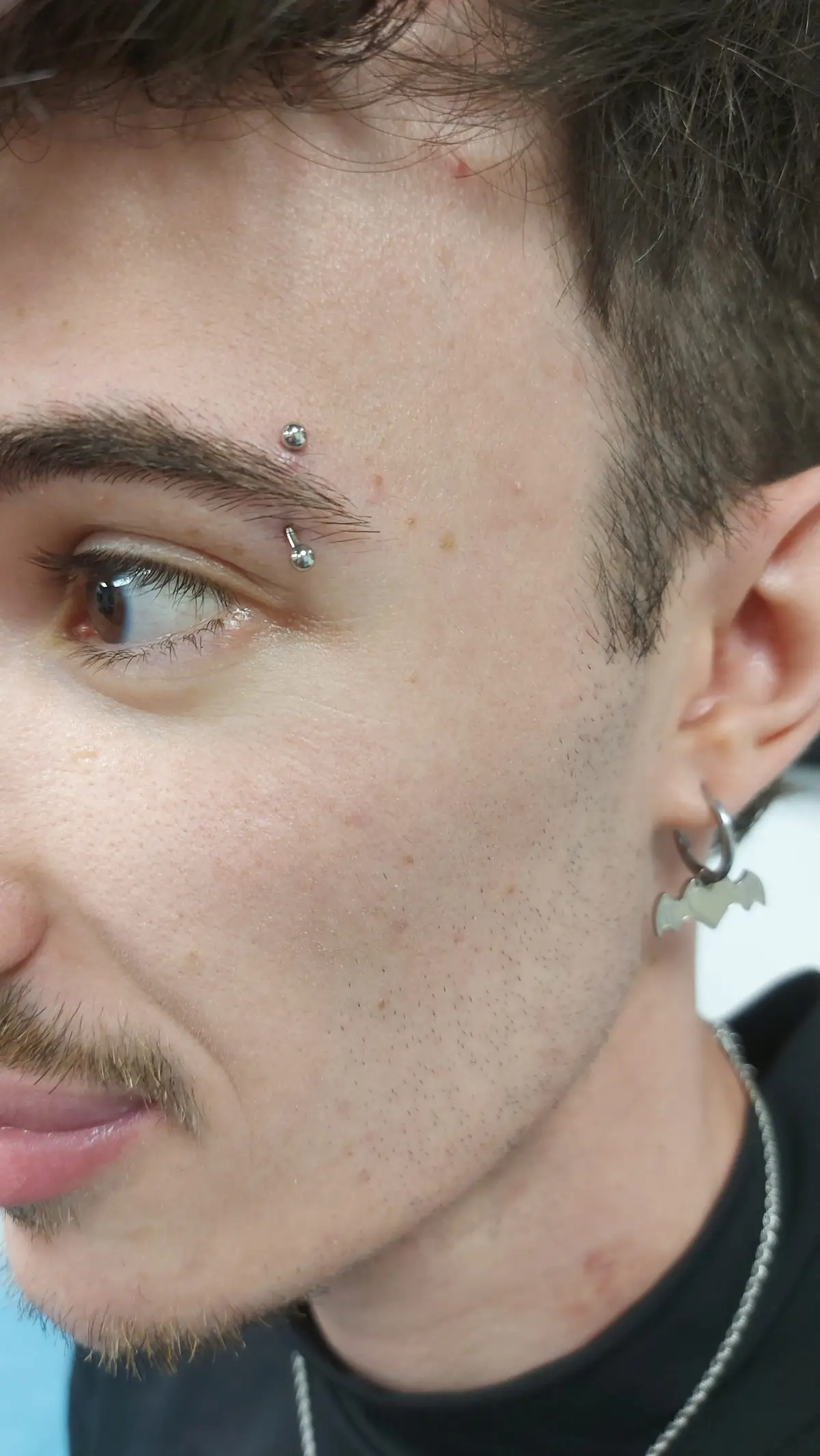
Each area has different particularities.
Ear cartilage has less vascularisation than the lobe, oral piercings can affect teeth and gums, and surface piercings can migrate more easily.
Therefore, general recommendations must be supplemented with specific instructions for the area and mounted jewellery.
Possible complications.
Signs and risks differ depending on anatomy, area and individual healing process.
Infection.
Progressive pain, spreading redness, local heat, pus or fever require medical evaluation.
Reaction to jewellery.
Irritation and itching can be caused by sensitivity, pressure, friction or unsuitable jewellery.
Bleeding and haematoma.
Minor bleeding may occur immediately. Persistent bleeding or significant swelling must be checked.
Abnormal scarring.
Hypertrophic scars or keloids may appear, especially in predisposed individuals.
Migration and rejection.
Jewellery can move towards the surface, and tissue between entry points can thin.
Snagging and tearing.
Clothes, towels, headphones or accidental contact can cause irritation and local trauma.
Specific risks depending on area.
Ear cartilage
Helix, Flat, Rook, Tragus, Daith or Industrial piercings heal slower than the lobe. Pressure during sleep, headphones and repeated trauma can prolong healing. Cartilage infections must be evaluated quickly.
Oral piercings
Tongue, lip, Smiley or Marley piercings can cause swelling, gum irritation, contact with teeth and temporary difficulties in speech or chewing. Severe swelling, difficulty swallowing or breathing require immediate medical help.
Nasal and facial piercings
Nostril, Septum, Bridge and eyebrow can be irritated by cosmetics, glasses, towels or repeated touching. Surface piercings have a higher risk of migration.
Nipple and intimate area piercings
Friction, pressure, sexual contact and premature jewellery change can delay healing. These procedures are performed only on persons aged 18 or over.
For a complete presentation of the procedure, see How a piercing is done, and for jewellery selection consult Jewellery for Piercing.
Seek medical evaluation for fever, chills, increasing pain, spreading redness, pus, severe swelling, red streaks on skin, altered general condition, difficulty swallowing or breathing. Do not remove jewellery from a suspected infection area without medical professional advice.
Piercing and evaluation in Bucharest.
2nd Face Tattoo & Body Piercing is located in the COCOR Store, basement, B-dul I.C. Brătianu 29–33, Sector 3, Bucharest, near Piața Unirii.
The studio uses medical steel jewellery. Appointment is required and made up to two days in advance.
Related pages.
Information about procedure, jewellery, care, healing and types of piercing.
Complete list of procedures and prices.
See the pageStages of a professional procedure.
See the pageWhat to expect during the procedure.
See the pageDiscomfort and influencing factors.
See the pageShapes, sizes, and jewellery choice.
See the pageTypes of jewellery for different areas.
See the pageInformation about medical steel.
See the pageThickness, length and diameter.
See the pageProper care after the procedure.
See the pageIndicative times and signs of healing.
See the pageMigration, rejection and other issues.
See the pageQuestions about appointments and care.
See the pageRules applicable to minors.
See the pageOptions for nose, eyebrow and lips.
See the pageRisks and care for the nasal area.
See the pageNostril piercing.
See the pageNasal septum piercing.
See the pageSurface facial piercing.
See the pageParticularities of oral piercing.
See the pageUpper lip frenulum piercing.
See the pagePiercing in the ear cartilage.
See the pagePiercing in the upper cartilage.
See the pageDermal anchor and risk of migration.
See the pageProcedure available only for 18+.
See the pageInformation about intimate procedures.
See the pageConditions for access and procedure performance.
See the pageAddress, phone and WhatsApp.
See the pageFrequently asked questions.
What are the main risks of a piercing?
The main risks are infection, reaction to jewellery material, bleeding, hematoma, abnormal scarring, migration or rejection and complications specific to the pierced area.
What symptoms may indicate an infection?
Spreading redness, progressive pain, local heat, marked swelling, purulent discharge, fever or chills require medical evaluation.
Is a little bleeding normal?
Minor bleeding may occur immediately after the procedure. Persistent, abundant or recurring bleeding must be evaluated.
Can a reaction to jewellery occur?
Yes. Some people may be sensitive to certain alloys. At 2nd Face, medical steel jewellery is used, and known allergies must be communicated before the procedure.
What does piercing migration mean?
Migration means the gradual movement of jewellery towards the skin surface. Tissue thinning or visible position change must be checked by the piercer.
When should a doctor be consulted?
For fever, increasing pain, spreading redness, purulent discharge, severe swelling, breathing difficulties, swallowing difficulties or altered general condition, medical evaluation is necessary.
Is an appointment necessary?
Yes. An appointment for piercing is necessary and made up to two days in advance.
Inform yourself beforehand. Care properly afterwards.
A procedure suitable for anatomy and consistent care reduce the risk of complications.